1. Exact Palette Locking
Every pixel stores an integer index 0..N mapped to a locked hex palette (Sweetie 16, Endesga 16, Dungeon Apollo, PICO-8, or custom). Index 0 is mathematically guaranteed RGBA (0,0,0,0) — zero dirty background halos.
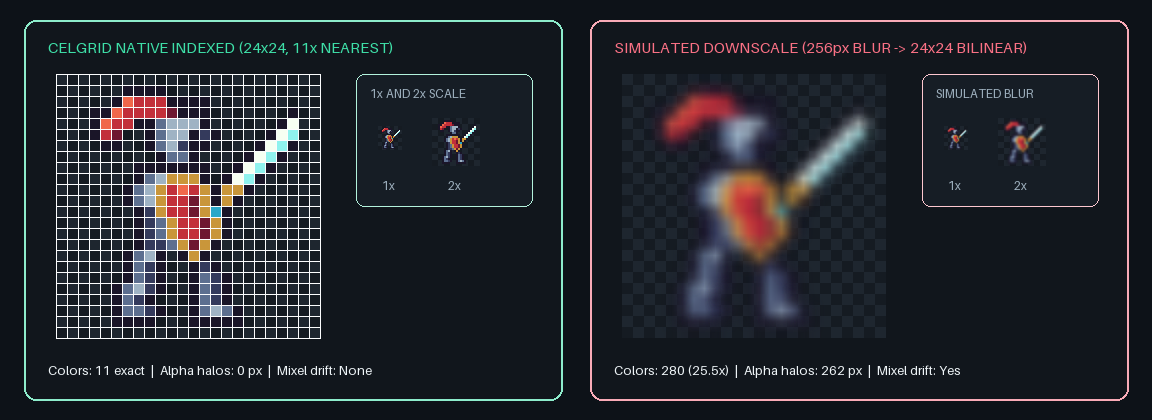
9ff39b5dd667: Left shows the exact native 24x24 indexed pixel grid scaled 11x nearest-neighbor alongside true 1x and 2x previews (11 locked RGBA colors, 0 semi-transparent pixels). Right shows the exact same silhouette passed through a simulated 256px bicubic upscale, Gaussian blur (r=2.2), and bilinear downscale back to 24x24, producing 280 blended RGBA values and 262 semi-transparent fringe pixels.
Every pixel stores an integer index 0..N mapped to a locked hex palette (Sweetie 16, Endesga 16, Dungeon Apollo, PICO-8, or custom). Index 0 is mathematically guaranteed RGBA (0,0,0,0) — zero dirty background halos.
At 16x16 or 24x24, a single misplaced pixel breaks an eye or sword edge. Celgrid's Pass 1 (Silhouette) and Pass 2 (Cluster Shading) build intentional contiguous color clusters instead of noisy averaged blocks.
Pass 3 renders both a zoomed gridded view and a true 1x game-scale preview (plus an animated contact sheet across all frames) so Claude Vision catches foot slide, proportion drift, or silhouette gaps before the sprite lands in your library.
| Engine Requirement | Celgrid Native Indexed Grid | Simulated Bilinear Downscale |
|---|---|---|
| Color count on 24x24 sprite | 11 exact locked colors | 280 blended RGBA colors (breaks shader palette swaps) |
| Semi-transparent outline fringe | 0 pixels (clean binary alpha) | 262 halo pixels (visible grey/dark seam on bright tiles) |
| Pixel uniformity (no mixels) | 100% uniform 1x1 integer cells | Irregular blurred transitions under integer zoom |
| Manual pixel editability | Instant 1-click color replace and pixel paint (0 cr) | Requires re-indexing, halo cleanup, and hand redrawing in Aseprite |
| Turnkey engine import | Godot 4 .tres/.tscn, Unity C#, Phaser 3 JSON | Manual slicing, quantization, and pivot alignment |
Mixels (mixed pixels) occur when a sprite contains blocks of inconsistent physical sizes (for example 1x1, 1.5x1, and 2x2 squares inside one frame). They happen when high-resolution continuous images are downscaled or transformed with bilinear or bicubic resampling rather than drawn on a discrete integer grid.
We took Celgrid's real starter sprite Crypt Knight Attack (24x24) directly from the starter catalog (11 exact RGBA colors, 0 semi-transparent edge pixels) and ran a controlled Pillow resampling simulation: 256px bicubic upscale, Gaussian blur (radius 2.2), and bilinear downscale back to 24x24. That simulation produced 280 blended RGBA colors (25.5x bloat) and 262 alpha-halo pixels. It demonstrates resampling contamination reproducibly rather than benchmarking a specific third-party diffusion model.
Celgrid synthesizes discrete integer index grids directly on a locked palette (Pass 1 Silhouette -> Pass 2 Cluster Shading -> Pass 3 Vision Self-Critique on a rendered 1x + zoomed contact sheet), so blurry intermediate colors can never enter the sprite matrix.
Yes. Native indexed pixels stay crisp only when the game engine samples textures with Nearest / Point filtering and uncompressed RGBA. Celgrid pre-wires Nearest filtering inside its Godot 4 .tscn, Unity C# importer, and Phaser 3 setup.
Open Crypt Knight Attack or any of the starter sprites at 1x and 8x zoom, edit pixels free, and export straight to Godot 4, Unity, or Phaser.